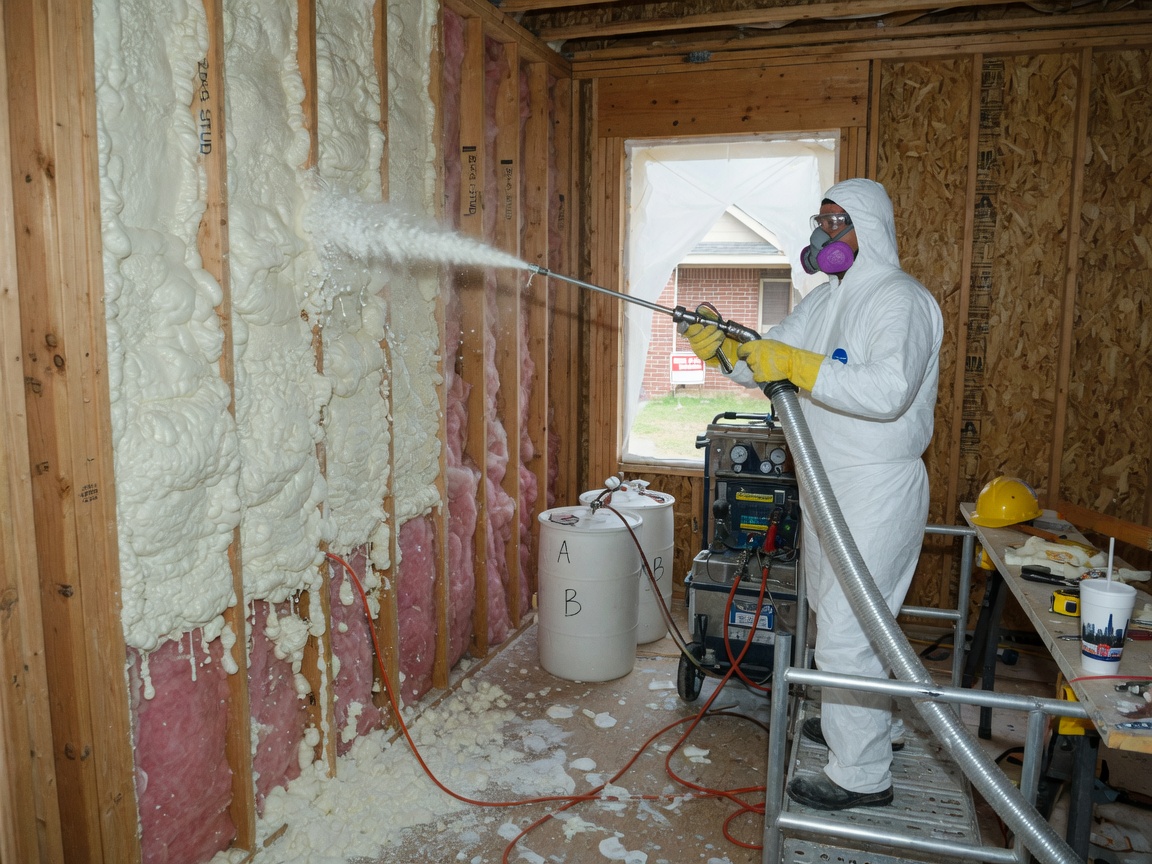
Oklahoma City wall cavities in Midtown and Capitol Hill homes built before 1960 often contain plaster over wood lath or early fiberglass that has settled. Warm humid summers drive moisture through these walls while winter lows push heat loss. Closed cell spray foam applied from the interior creates a continuous air seal and adds structural rigidity without requiring full wall demolition. Technicians must check for knob-and-tube wiring and knob spacing before drilling because expanding foam can displace loose connections. In Bricktown commercial conversions the same product stops wind-driven rain from the Bricktown Canal area that regularly reaches second-floor walls.
Open cell foam is chosen for attics and interior partitions in newer Moore and Midwest City subdivisions where vapor drive is lower. It expands to fill irregular stud bays around plumbing and electrical runs common in 1980s tract homes. Both products are applied only after confirming no active roof leaks, because trapped moisture behind closed cell foam leads to rot in the sill plates that sit on Oklahoma County clay soils. Crews mask outlets and windows first, then use infrared scans to locate missed voids before trimming excess. Homeowners in The Village and Warr Acres notice immediate reduction in dust and pollen infiltration once the walls are sealed.
Severe thunderstorms bring rapid temperature swings that cause older brick homes in Automobile Alley to expand and contract. Spray foam must be applied in lifts no thicker than two inches per pass to avoid cracking the existing plaster. Edge cases include balloon-framed walls in Deep Deuce where fire stops are missing; foam is used to create new draft stops at each floor line. Access through small holes drilled from the basement or attic minimizes finish damage. After curing, a thermal barrier coating is applied wherever the foam remains exposed per local code requirements.
Technician insight
In Oklahoma City the thing that catches most people out with Wall Spray Foam Insulation is the knob-and-tube wiring still present in 1920s–1940s homes around Capitol Hill and Deep Deuce. Foam expands quickly and can push loose connections if the wiring is not identified first. Clay soils and frequent thunderstorms also mean we always check for existing moisture before closing the cavities.
Midtown Duplex Wall Fill
A 1948 duplex near NW 23rd Street showed high summer humidity and winter drafts through plaster walls. Assessment found settled fiberglass and active knob-and-tube circuits. Closed cell foam was applied in two-inch lifts from the attic and basement after circuits were secured. Homeowners reported steady interior temperatures and no more visible dust on window sills during thunderstorm season.
Wall Spray Foam Insulation Services We Offer
✓Closed Cell Wall Cavity Fill
High-density closed cell foam injected into existing stud bays to add R-value and air sealing in Bricktown and Midtown homes.
✓Open Cell Retrofit Insulation
Lower-density open cell foam used in interior walls where sound control and vapor permeability are priorities in Edmond and Norman residences.
✓Wall Insulation for Historic Conversions
Careful cavity fill in pre-1950 structures around the Oklahoma State Capitol that preserves plaster while stopping air leakage.
✓Moisture and Air Sealing Package
Combined wall and rim-joist treatment that addresses thunderstorm-driven humidity entering homes in Del City and Midwest City.
✓New Construction Wall Spray
Full cavity spray in stick-built homes throughout Bethany and Warr Acres before drywall installation.
Wall Spray Foam Insulation Cost in Oklahoma City, OK
| Service | Typical Range | What Affects It |
|---|---|---|
| Closed cell wall fill | $1.80–$2.60 per sq ft | Higher price for tight access or multiple small cavities in older Midtown homes. |
| Open cell wall fill | $1.10–$1.70 per sq ft | Lower cost option for interior partitions in newer Moore and Edmond homes. |
| Historic home wall insulation | $2.20–$3.00 per sq ft | Includes extra protection and smaller lift applications for plaster walls. |
| On-site assessment | Free | Required before any quote; covers Oklahoma City and nearby cities. |
Ranges are typical for Oklahoma City, OK and confirmed with an exact written quote before any work starts.
How it works
- 1
Site Assessment
Technician inspects wall cavities, wiring, and moisture levels at the Oklahoma City address and measures square footage.
- 2
Preparation and Masking
Furniture and finishes are protected, outlets masked, and small access holes drilled from least visible locations.
- 3
Foam Application
Material is sprayed in controlled lifts while monitoring temperature and humidity common during Oklahoma County summers.
- 4
Trim and Finish
Excess foam is trimmed flush, holes are patched, and thermal barrier is applied where required.
Pricing
Quotes are calculated from square footage, wall access difficulty, and foam type after an on-site visit.