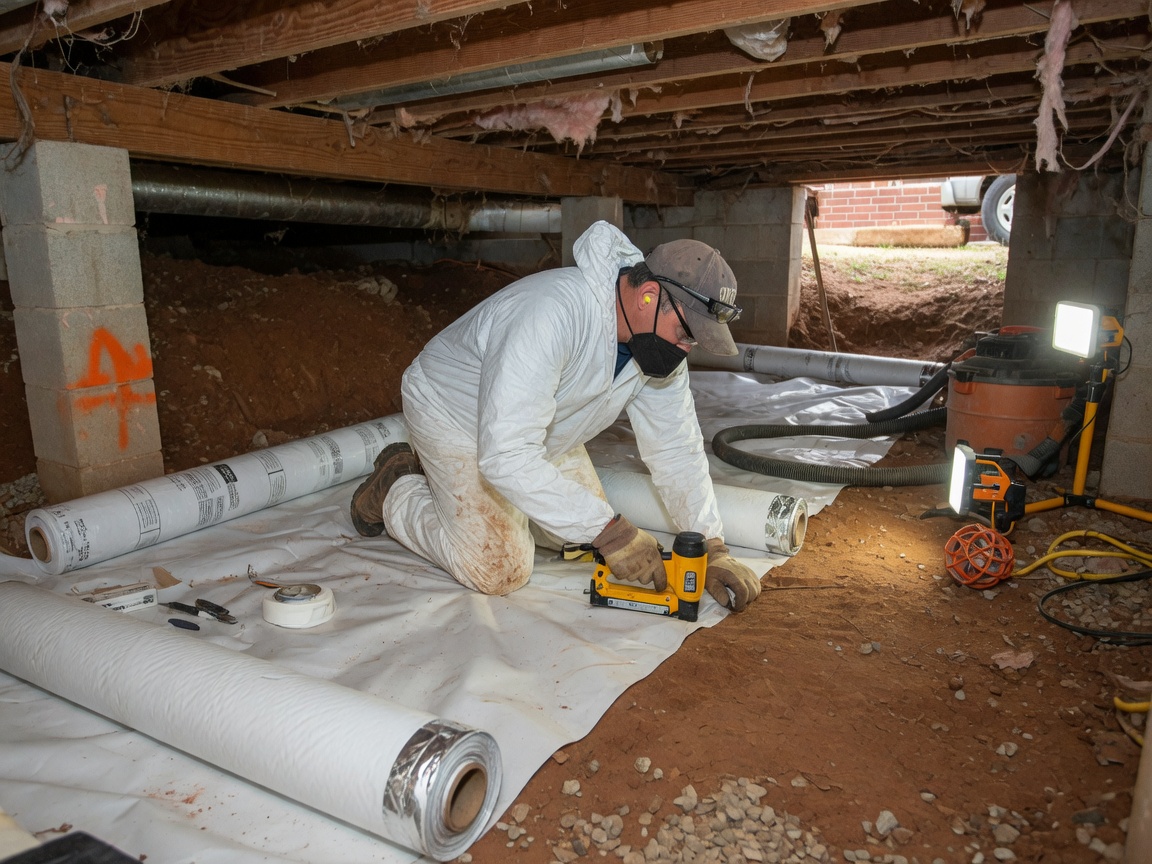
Oklahoma County homes built before 1980 often sit on pier-and-beam foundations with vented crawl spaces that pull in warm humid air during summer and allow cold air infiltration in winter. Severe thunderstorms dump several inches of rain quickly, and water migrates under the vapor barrier or through foundation vents into the space. Encapsulation replaces vents with sealed rigid foam or closed-cell spray foam walls, installs a 20-mil reinforced liner sealed to the foundation and piers, and ties the space into the conditioned envelope so the HVAC system can control humidity year-round.
Edge cases appear regularly in neighborhoods such as Midtown, Capitol Hill, and The Village where mature trees and clay-heavy soil create poor drainage. Standing water after storms can push against the liner seams if they are not mechanically fastened and taped with mastic. Older Stockyards City and Automobile Alley properties sometimes have low clearance or buried utilities that require custom access panels and careful insulation detailing around plumbing and electrical runs. We always inspect for active leaks and recommend sump integration before the liner goes down.
Code compliance in Oklahoma City requires that any conditioned crawl space meet the same insulation and vapor retarder standards as the rest of the building envelope. Leaving original fiberglass batts in place traps moisture against joists; removal and replacement with closed-cell foam or rigid board prevents this. Homeowners in Warr Acres and Bethany frequently notice reduced musty odors and lower cooling loads once the space is sealed and dehumidified.
Technician insight
In Oklahoma City the thing that catches most people out with crawl space encapsulation is how quickly clay soil and severe thunderstorms push water under the liner if the seams are not mechanically fastened and the grade around the house slopes inward. Older homes in Midtown and Capitol Hill almost always need the original vents removed and the rim joists foamed, otherwise humidity from warm humid summers keeps cycling through the space.
Midtown Home After Spring Storms
Water was entering the crawl space of a 1960s pier-and-beam house in Midtown after every thunderstorm. We found saturated soil against the foundation and failed original vents. After installing a sealed liner, closed-cell foam on the walls, and an integrated dehumidifier, humidity dropped below 50 percent and stayed there through the next rainy season.
Crawl Space Encapsulation Services We Offer
✓Vapor Barrier Installation
Heavy-duty 20-mil reinforced liner sealed to walls, piers, and foundation prevents ground moisture from entering Oklahoma City crawl spaces during humid summers and thunderstorms.
✓Crawl Space Insulation
Closed-cell spray foam applied to rim joists and walls keeps conditioned air inside and blocks cold winter air infiltration common in Bricktown and Midtown homes.
✓Dehumidifier Integration
Whole-crawl-space dehumidifiers sized for Oklahoma County humidity levels maintain 45-55 percent RH and protect against mold after heavy rain events.
✓Sump Pump and Drainage Upgrade
Interior French drain and sump pump systems handle stormwater that collects under homes in low-lying areas such as Del City and Midwest City.
✓Access Door and Vent Sealing
Insulated, gasketed access doors replace vented crawl space doors in neighborhoods like Bethany and Moore to stop outside air exchange.
Crawl Space Encapsulation Cost in Oklahoma City, OK
| Service | Typical Range | What Affects It |
|---|---|---|
| Basic Encapsulation (under 800 sq ft) | $3,000–$4,500 | Includes liner, rim insulation, and sealed door; price rises with poor access or debris removal. |
| Full Encapsulation With Dehumidifier | $5,500–$8,000 | Adds whole-space dehumidifier sized for Oklahoma County humidity; common in Moore and Edmond homes. |
| Sump Pump And Drainage Add-On | $1,200–$2,800 | Required when water collects after thunderstorms in low-lying Oklahoma County lots. |
Ranges are typical for Oklahoma City, OK and confirmed with an exact written quote before any work starts.
How it works
- 1
Site Inspection And Moisture Assessment
We evaluate drainage around the foundation, check for standing water, and measure humidity levels in homes across Oklahoma County.
- 2
Preparation And Material Removal
Old insulation, debris, and failing vapor barriers are removed; any active leaks are documented before liner installation begins.
- 3
Liner And Insulation Installation
The 20-mil liner is mechanically fastened and sealed, then closed-cell foam is applied to walls and rim joists in one continuous air barrier.
- 4
Conditioning And Final Testing
A dehumidifier or HVAC connection is added, vents are sealed, and the space is tested for airtightness and humidity control.
Pricing
Most Oklahoma City crawl space encapsulation projects fall between $3,000 and $8,000 depending on square footage, access, and drainage needs.